
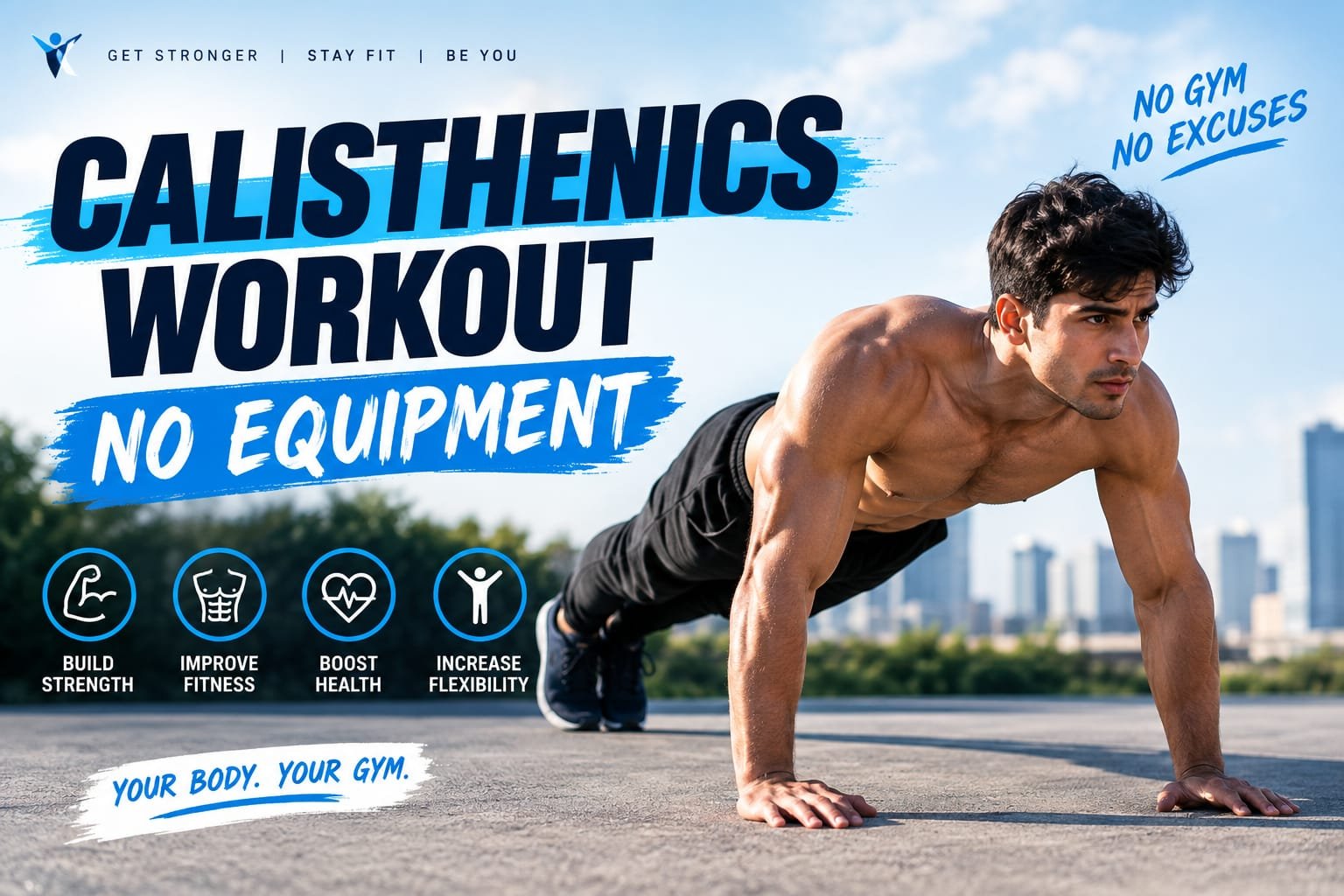
Calisthenics Workout no Equipment: Complete Beginner Guide
Calisthenics Workout no Equipment is a practical way to build strength, improve mobility, and stay active by using body weight as resistance. It does not require a gym membership, dumbbells, machines, or expensive fitness equipment. With enough space to move safely, a person can perform an effective workout at home, outdoors, or almost anywhere else.
For beginners, calisthenics can also make exercise easier to approach because many movements have simple progressions. This guide explains what calisthenics is, its benefits, the best exercises to start with, how to structure a routine, and how to make steady progress without equipment.
What Is Calisthenics?
Calisthenics is a form of strength and fitness training that primarily uses a person’s body weight as resistance. Common movements include squats, push-ups, lunges, planks, mountain climbers, and other exercises that require controlled movement.
Unlike traditional resistance training, calisthenics does not depend on adding weight to make an exercise challenging. Difficulty can instead be adjusted by changing repetitions, tempo, range of motion, rest periods, exercise variations, or body position.
This makes calisthenics suitable for different fitness levels. A beginner can start with an easier variation and gradually move toward more challenging movements as strength and coordination improve.
Benefits of a Calisthenics Workout no Equipment
Builds Full-Body Strength
A well-planned bodyweight routine can train most of the major muscle groups. Squats and lunges challenge the lower body, while push-ups work the chest, shoulders, and triceps. Planks and similar movements add a core-strengthening component.
A balanced workout can therefore provide a useful combination of upper-body, lower-body, and core training without requiring several pieces of equipment.
Easy to Perform at Home
One of the biggest advantages is convenience. Many calisthenics movements require only a small amount of clear floor space.
A bedroom, living room, backyard, park, or other safe area may be enough for a basic session. This convenience can remove some of the common barriers that make regular exercise difficult.
Supports Better Body Control
Calisthenics involves more than simply completing repetitions. Many exercises require balance, coordination, stability, and control.
For example, a slow bodyweight squat requires the person to control the descent, maintain a stable position, and return to standing without losing balance. Regular practice can help improve awareness of how the body moves.
Can Fit Different Fitness Levels
Bodyweight exercises can often be modified to make them easier or harder.
A beginner struggling with standard push-ups can start with an easier variation. As strength develops, the person can gradually move toward standard push-ups or more demanding variations.
This gradual approach allows training to develop alongside the individual’s ability.
Makes Consistent Training More Practical
A workout that requires little preparation can be easier to fit into a busy schedule. There is no need to travel to a gym, set up a collection of weights, or wait for a machine to become available.
Consistency remains important, and a simple routine that can be performed regularly may be more practical than an unnecessarily complicated program.
7 Beginner Exercises to Try
A beginner can build a balanced routine by combining exercises that target the upper body, lower body, and core.
1. Bodyweight Squats
Bodyweight squats are a fundamental lower-body movement. They primarily train the quadriceps, glutes, and hamstrings while also requiring core stability.
To perform a squat, the person stands with the feet approximately shoulder-width apart. The hips are pushed backward while the knees bend, and the body lowers under control. The person then presses through the feet to return to the standing position.
A beginner can start with around 8–15 controlled repetitions.
2. Push-Ups
Push-ups are one of the most useful upper-body exercises in a bodyweight routine. They primarily challenge the chest, shoulders, and triceps while the core works to keep the body stable.
A beginner who cannot yet perform a standard push-up can use a modified variation and gradually build strength.
The main focus should remain on controlled movement rather than completing as many repetitions as possible.
3. Reverse Lunges
Reverse lunges train the legs and glutes while adding a balance component.
The person begins standing upright, steps one foot backward, and lowers the body while keeping the front leg stable. The front foot is then used to return to the starting position before switching sides.
Performing the movement slowly can help a beginner develop better control and balance.
4. Glute Bridges
Glute bridges are performed on the floor and primarily target the glutes.
The person lies on the back with the knees bent and feet placed on the floor. The hips are then raised while the glutes contract. After a brief pause, the hips are lowered in a controlled manner.
This movement can be useful for strengthening the posterior chain while remaining relatively simple to learn.
5. Planks
Planks are an isometric exercise that challenges the core and requires the body to remain stable.
A beginner can start with a short hold while concentrating on maintaining a straight and controlled body position. The duration can gradually increase as the person becomes more comfortable.
Quality of positioning is more important than simply holding the plank for as long as possible.
6. Mountain Climbers
Mountain climbers combine core stability with repeated leg movement. They can also raise the heart rate and add a conditioning element to a workout.
The person begins in a high-plank position and alternately brings the knees toward the chest while keeping the upper body controlled.
Beginners can perform the movement slowly before gradually increasing the pace.
7. Calf Raises
Calf raises are a simple way to include lower-leg training in a bodyweight routine.
The person stands upright and slowly raises the heels from the floor before lowering them again. A wall or stable surface can be used for balance when necessary.
Controlled repetitions can help keep the exercise focused on the calf muscles.
How to Structure a No-Equipment Workout
A beginner does not need a complicated training plan. A simple full-body session can include a lower-body exercise, an upper-body movement, a core exercise, and an optional conditioning movement.
For example:
| Exercise | Suggested Starting Point |
|---|---|
| Bodyweight squats | 2–3 sets of 8–15 reps |
| Push-ups or an easier variation | 2–3 sets of 5–12 reps |
| Reverse lunges | 2 sets of 8–12 reps per side |
| Glute bridges | 2–3 sets of 10–15 reps |
| Plank | 2 sets of 15–30 seconds |
| Mountain climbers | 2 sets of 20–30 seconds |
These numbers are starting guidelines rather than fixed requirements. Fitness level, exercise experience, recovery, and technique can all affect the appropriate workload.
How Often Should Beginners Train?
A beginner can start with around two or three sessions per week, leaving recovery time between demanding workouts.
Training every day is not necessary to make progress. Muscles and other tissues need time to recover from physical stress, particularly when someone is new to exercise.
A schedule such as Monday, Wednesday, and Friday can provide training days separated by recovery periods. Another schedule may work equally well if it fits the person’s routine.
The important consideration is creating a manageable pattern that can be maintained consistently.
How to Make Calisthenics More Challenging
Bodyweight training can become progressively harder without adding external weight.
Increase Repetitions
When an exercise becomes comfortable, additional repetitions can increase the workload. However, repetitions should not be increased at the expense of proper technique.
Slow Down the Movement
A slower tempo can make a familiar movement more demanding. For example, taking several seconds to lower during a squat or push-up can increase the time the muscles spend under tension.
Use More Difficult Variations
Exercise variations can provide another way to progress.
A person may progress from an easier push-up variation to a standard push-up and eventually explore more challenging variations. Similar progressions can be applied to squats, lunges, planks, and other movements.
Reduce Rest Gradually
Reducing rest periods can make a workout more demanding, particularly when the goal includes muscular endurance or conditioning.
However, rest should remain long enough to allow the person to maintain reasonable technique.
Common Mistakes to Avoid
Doing Too Much Too Soon
Beginners sometimes increase repetitions, workout frequency, or exercise difficulty too quickly. This can make recovery more difficult and may interfere with consistent training.
Gradual progression is generally more practical than attempting an extremely demanding session at the beginning.
Ignoring Exercise Technique
Good technique helps a person control each movement and train the intended muscles more effectively.
A smaller number of controlled repetitions can be more useful than rushing through a large number with poor form.
Skipping the Warm-Up
A short warm-up can prepare the body for movement. Light activity followed by dynamic movements can help increase body temperature and prepare the joints and muscles for the upcoming session.
Neglecting Recovery
Rest is part of a training routine. Adequate sleep, hydration, balanced nutrition, and recovery days can all support regular exercise.
Persistent pain, unusual fatigue, or other concerning symptoms should not simply be ignored.
Tips for Staying Consistent
A sustainable routine is usually easier to maintain when it fits naturally into everyday life.
A person can choose a convenient workout time, keep sessions reasonably short, and track progress through repetitions or exercise variations. Setting small milestones can also make progress easier to recognize.
For example, completing more controlled push-ups than before or holding a plank for longer can provide a clear indication of improvement.
The goal does not have to be completing the hardest possible exercise. Building a routine that can be maintained over time is often a more practical approach.
Safety Considerations
A clear, stable exercise area should be used for bodyweight training. Beginners should learn the basic movement pattern before increasing repetitions or difficulty.
Exercise should generally feel challenging without causing sharp or unusual pain. If pain occurs during a movement, the person should stop and assess the situation rather than attempting to push through it.
People with existing medical conditions, injuries, or specific health concerns may benefit from professional guidance before starting a new exercise program.
Conclusion
A Calisthenics Workout no Equipment routine can provide a convenient way to develop strength, mobility, balance, and general fitness without relying on a gym or expensive equipment. Exercises such as squats, push-ups, lunges, glute bridges, planks, mountain climbers, and calf raises can form the foundation of a practical full-body routine.
The most effective approach for a beginner is to start at an appropriate level, focus on controlled technique, allow sufficient recovery, and increase the challenge gradually. With regular practice and realistic progression, bodyweight training can become a simple and sustainable part of an active lifestyle.




[…] to gradually transition from exercise to rest. Rather than ending an intense workout suddenly, a beginner can spend several minutes slowing down and focusing on controlled […]