
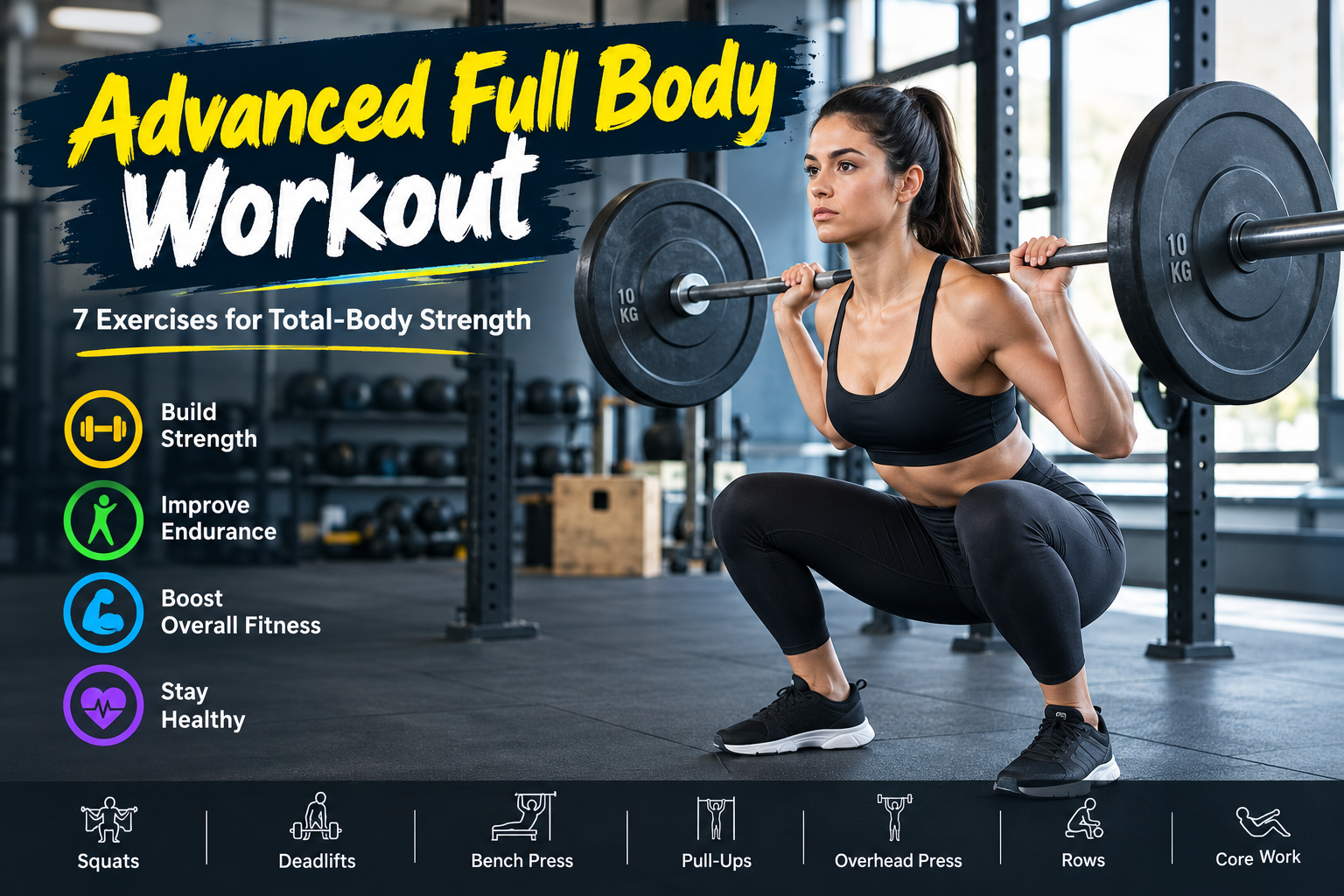
Advanced Full Body Workout: 7 Exercises for Total-Body Strength
Advanced full Body Workout training is designed for experienced exercisers who want to challenge multiple muscle groups in a single session. Unlike a beginner routine, an advanced program requires greater attention to exercise selection, training volume, intensity, technique, and recovery.
A well-structured full-body routine can help an experienced trainee develop strength, muscular endurance, coordination, and overall fitness without requiring a separate workout for every muscle group. The key is to create enough training stimulus while still allowing the body adequate time to recover.
This guide explains how to structure an advanced full-body routine, which exercises can form its foundation, how to manage intensity, and how to make training sustainable over time.
What Is an Advanced Full Body Workout?
An advanced full-body workout combines movements that challenge the major muscle groups during the same training session. Rather than concentrating exclusively on the chest, back, legs, or shoulders, the routine uses compound and supporting exercises to train the body as an integrated system.
Experienced trainees generally have a better understanding of exercise technique and training intensity, allowing them to use more demanding variations. However, advanced training should not simply mean lifting heavier weights. Controlled movement, appropriate exercise selection, progressive overload, and recovery remain important.
A typical session may include:
- A lower-body compound movement
- An upper-body pushing movement
- An upper-body pulling movement
- A hip-dominant exercise
- A shoulder or accessory movement
- A core exercise
- Optional conditioning work
The exact structure can be adjusted according to an individual’s goals, experience, available equipment, and recovery capacity.
Benefits of Advanced Full Body Workout Training
Efficient Training
Training several major muscle groups in one session can make efficient use of gym time. Instead of dedicating separate days exclusively to individual body parts, an experienced trainee can stimulate the upper body, lower body, and core within one workout.
This can be particularly useful for people who cannot consistently train five or six days each week.
Supports Strength Development
Compound movements allow several muscles and joints to work together. Exercises such as squats, deadlifts, presses, and rows can provide substantial resistance-training stimulus while also requiring coordination and stability.
Strength development depends on consistent training and progressive overload rather than simply increasing the weight as quickly as possible.
Helps Maintain Training Variety
Repeating exactly the same exercises and rep ranges for long periods can make training feel monotonous. An advanced routine can introduce different exercise variations, tempos, rep ranges, and equipment while maintaining the same fundamental movement patterns.
Allows Flexible Weekly Scheduling
A full-body approach can work with different schedules. Depending on training volume and recovery, some experienced trainees may use two, three, or more sessions per week.
The important consideration is not simply how often someone trains but whether the total workload can be recovered from and maintained consistently.
7 Exercises for an Advanced Full Body Workout
1. Barbell Squat
The barbell squat is a demanding lower-body compound movement that primarily trains the quadriceps and glutes while also involving the trunk and other supporting muscles.
An experienced trainee should maintain a stable position throughout the movement and use a range of motion that can be controlled safely. Heavy loading should only be used when technique remains consistent.
A practical approach is to perform several controlled working sets rather than repeatedly training to complete muscular failure.
2. Romanian Deadlift
The Romanian deadlift emphasizes the posterior chain, including the hamstrings and glutes. It also challenges the muscles responsible for maintaining a stable trunk.
The movement begins from a standing position. The hips move backward while the torso inclines forward under control, keeping the weight close to the body. The hips then drive forward to return to the starting position.
Because the exercise places considerable demand on the posterior chain, excessive loading can compromise technique. Controlled repetitions are more useful than chasing unnecessary weight.
3. Bench Press
The bench press provides a primary horizontal pushing movement. It trains the chest, shoulders, and triceps while requiring stability through the upper body.
An experienced lifter can vary the exercise with different grips, angles, or equipment. However, each variation should have a clear purpose rather than being added simply to make the workout more complicated.
4. Pull-Ups
Pull-ups provide a challenging vertical pulling movement and involve the back, biceps, shoulders, and core.
An experienced trainee who can comfortably perform bodyweight repetitions may gradually introduce additional resistance. Quality repetitions should remain the priority, particularly when fatigue increases later in the workout.
5. Overhead Press
The overhead press adds another compound movement for the shoulders and triceps while requiring the trunk to stabilize the body.
A controlled press should begin with the weight positioned appropriately near shoulder level before moving upward. The lifter should avoid using excessive momentum to complete repetitions.
6. Dumbbell Row
A dumbbell row complements vertical pulling movements by training the upper back through a horizontal pulling pattern.
The exercise can be performed with one arm at a time, allowing the trainee to focus on controlled movement and balanced development. The torso should remain stable rather than rotating excessively during each repetition.

7. Hanging Leg Raise
A hanging leg raise can provide a challenging core movement at the end of a full-body session. It requires the abdominal muscles and hip flexors to control the movement while the upper body maintains a stable hanging position.
Beginners to this exercise can use a modified variation, while experienced trainees can increase difficulty through controlled tempo or additional range of motion.
How to Structure the Workout
Exercise selection is only one part of an effective program. The order, volume, intensity, and rest periods also influence the quality of the session.
A sample structure could look like this:
| Exercise | Sets | Repetitions |
|---|---|---|
| Barbell Squat | 3–4 | 5–8 |
| Romanian Deadlift | 3 | 6–10 |
| Bench Press | 3–4 | 6–10 |
| Pull-Ups | 3 | 6–10 |
| Overhead Press | 2–3 | 8–10 |
| Dumbbell Row | 2–3 | 8–12 |
| Hanging Leg Raise | 2–3 | 8–15 |
These figures are examples rather than universal requirements. An experienced trainee should adjust volume and resistance according to training history, goals, recovery, and technique.
How to Use Progressive Overload
Progressive overload means gradually increasing the training challenge as the body adapts. Increasing weight is one method, but it is not the only option.
Progress can also come from:
- Adding repetitions while maintaining good technique
- Increasing resistance gradually
- Adding a set when appropriate
- Improving movement control
- Increasing range of motion
- Using a more demanding exercise variation
- Managing rest periods appropriately
Progress should be measurable but gradual. A sudden increase in workload can make recovery more difficult and may reduce workout quality.
How Many Days a Week Should an Advanced Trainee Train?
There is no single weekly schedule that suits every experienced exerciser. A full-body program can be performed on several different schedules depending on total volume and recovery.
For example, a three-day structure could look like:
Monday: Full-body strength session
Tuesday: Recovery or light activity
Wednesday: Full-body training
Thursday: Recovery or mobility work
Friday: Full-body training
Weekend: Rest or low-intensity activity
Another trainee may require fewer sessions because each workout contains a greater amount of training volume.
The best schedule is one that allows consistent performance without accumulating excessive fatigue.
The Importance of Recovery
A demanding training routine requires sufficient recovery. Muscles, connective tissues, and the nervous system all experience stress during challenging exercise.
Recovery can include:
Quality Sleep
Adequate sleep supports physical recovery and helps an individual feel prepared for subsequent training sessions.
Balanced Nutrition
A balanced diet provides energy and nutrients needed to support training and recovery. Protein-rich foods can contribute to maintaining and repairing muscle tissue, while carbohydrates provide an important source of training energy.
Rest Days
Rest days provide an opportunity to reduce training stress. They do not necessarily mean complete inactivity; light walking or mobility work may be appropriate when it feels comfortable.
Managing Training Fatigue
Persistent exhaustion, declining performance, poor sleep, or unusually prolonged soreness can indicate that training demands need to be reconsidered.
Common Mistakes to Avoid
Using Excessive Weight
Advanced training does not require every set to involve maximal weight. Excessive loading can make it difficult to maintain proper technique.
Training Every Set to Failure
Training to failure can have a place in some programs, particularly with selected accessory exercises. However, taking every compound movement to complete failure can increase fatigue and make recovery more difficult.
Ignoring Exercise Technique
Experience does not eliminate the need for good form. Even advanced trainees benefit from periodically reviewing movement quality and correcting technical weaknesses.
Doing Too Much Volume
More exercises and more sets do not automatically produce better results. Training volume should be appropriate for the individual’s ability to recover.
Neglecting Warm-Up
A structured warm-up can prepare the body for demanding movements. It may include general movement, mobility work, and progressively heavier preparation sets for the first major exercises.
How to Make the Routine Sustainable
A sustainable program should challenge the trainee without becoming unnecessarily difficult to maintain.
One useful approach is to track workouts over time. Recording exercises, weights, repetitions, and perceived difficulty can reveal whether performance is improving or whether fatigue is accumulating.
Exercise selection can also be rotated periodically. Instead of completely changing the program every week, an experienced trainee can retain the main movement patterns while making small adjustments.
For example, a conventional bench press could eventually be replaced with an incline dumbbell press for a training block. A back squat could be complemented or temporarily replaced by a front squat.
The objective is to create enough variation to maintain progress while preserving consistency.
Safety Considerations
Advanced resistance training places substantial demands on the body. Exercises should be performed with controlled technique and an appropriate level of resistance.
Anyone experiencing sharp pain, dizziness, unusual shortness of breath, or other concerning symptoms should stop exercising and seek appropriate professional guidance.
Individuals with injuries or relevant medical conditions should obtain advice from a qualified healthcare professional before beginning or significantly changing an intensive exercise program.
Conclusion
An Advanced full Body Workout can provide an efficient way for experienced trainees to challenge the major muscle groups while developing strength, endurance, coordination, and overall fitness. A balanced routine can combine compound movements such as squats, Romanian deadlifts, presses, pull-ups, and rows with targeted core work.
Long-term progress depends on more than exercise selection. Appropriate volume, progressive overload, sound technique, nutrition, sleep, and recovery all contribute to a sustainable training approach. By adjusting these elements according to individual needs, an experienced trainee can build a demanding routine without making training unnecessarily complicated.