Post Workout Stretching Routine for Beginners: Complete Guide
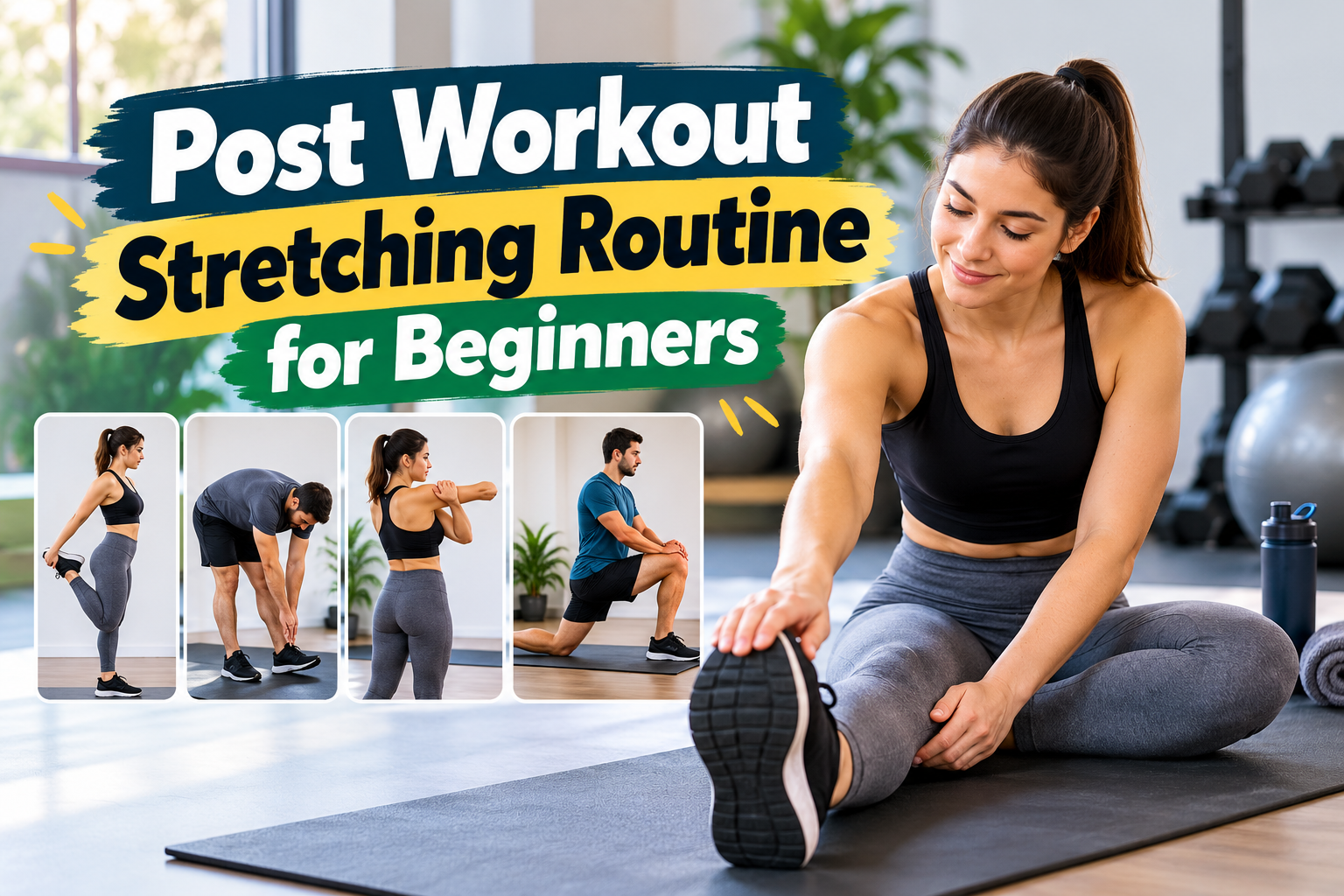
Post Workout Stretching Routine for Beginners is a simple way to cool down after exercise, work on flexibility, and help the body transition from an active workout to rest. Beginners often finish their final exercise and leave immediately, but adding a few gentle stretches can make the end of a workout feel more complete.
A good stretching routine does not need to be complicated or time-consuming. With a few basic movements for the major muscle groups, beginners can create a practical cool-down routine that fits after strength training, cardio, or a full-body workout.
This guide explains seven beginner-friendly stretches, how to perform them correctly, how long to hold them, and which common mistakes should be avoided.
Why Is Stretching After a Workout Important?
After exercise, the muscles that were heavily involved in training may feel tight or fatigued. Gentle static stretching can be used as part of the cool-down period to work on flexibility and range of motion.
Post-workout stretching also gives a person time to gradually transition from exercise to rest. Rather than ending an intense workout suddenly, a beginner can spend several minutes slowing down and focusing on controlled movements.
However, stretching should not be viewed as a guaranteed way to prevent all soreness or injuries. Its main role after exercise is to support flexibility, mobility, and a comfortable cool-down.
Post Workout Stretching Routine for Beginners
The following routine includes seven simple stretches that target several major muscle groups. Each stretch should feel gentle rather than painful.
Beginners can generally hold a comfortable static stretch for around 15–30 seconds before slowly releasing it. Both sides of the body should be stretched where appropriate.
1. Standing Quadriceps Stretch
The standing quadriceps stretch targets the muscles at the front of the thighs.
A person begins by standing upright near a wall or stable object for balance. One knee is bent, bringing the heel toward the buttocks. The ankle is then held gently while the knees remain relatively close together.
The stretch should be felt along the front of the thigh without pulling aggressively.
Hold: 15–30 seconds on each side.
2. Standing Hamstring Stretch
Hamstrings can feel tight after exercises such as squats, lunges, running, or cycling.
To perform this stretch, one foot is placed slightly forward with the heel on the floor and toes pointing upward. The opposite knee can remain slightly bent. The person then gently hinges forward from the hips while keeping the back in a comfortable position.
There should be a mild stretching sensation along the back of the thigh.
Hold: 15–30 seconds on each leg.
3. Calf Stretch
The calf muscles are active during walking, running, jumping, and many lower-body exercises.
A beginner can face a wall and place both hands against it. One leg steps backward while the front knee bends slightly. The back heel stays on the ground as the person gently leans forward.
The movement should create a comfortable stretch through the calf of the back leg.
Hold: 20–30 seconds per side.
4. Chest and Shoulder Stretch
Upper-body workouts can leave the chest and shoulders feeling tight.
A simple chest stretch can be performed while standing upright. The hands are gently brought behind the body, and the chest is opened without forcing the shoulders backward.
The movement should remain controlled, especially for anyone with limited shoulder mobility.
Hold: 15–30 seconds.
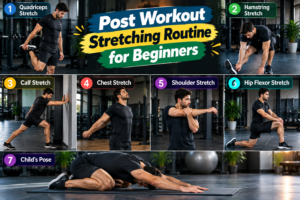
5. Cross-Body Shoulder Stretch
This easy stretch focuses primarily on the back and side of the shoulder.
One arm is brought across the chest. The opposite arm gently supports it and draws it slightly closer to the body. The shoulders should stay relaxed rather than lifting toward the ears.
Hold: 15–30 seconds on each arm.
6. Kneeling Hip Flexor Stretch
People who spend much of the day sitting may appreciate adding a hip-focused movement to their cool-down.
A beginner starts in a half-kneeling position with one knee on the floor and the opposite foot positioned in front. Keeping the torso upright, the hips move gently forward until a stretch is felt near the front of the hip on the kneeling side.
The lower back should not be excessively arched.
Hold: 20–30 seconds on each side.
7. Child’s Pose
Child’s pose provides a gentle way to finish the routine.
The person begins on the floor with the knees bent, then slowly moves the hips toward the heels while reaching the arms forward. The head and neck should remain relaxed.
Comfort is more important than reaching a specific position. If necessary, the knees can be adjusted to make the movement easier.
Hold: 20–30 seconds while breathing slowly.
How Long Should Beginners Stretch After a Workout?
A stretching session does not have to last a long time. Around 5–10 minutes can be enough for a basic beginner cool-down.
Instead of rushing through many different movements, a person can select stretches that target the muscles used most during the workout.
For example, after a leg workout, more attention may be given to the quadriceps, hamstrings, calves, and hips. After an upper-body session, the shoulders, chest, arms, and upper back may receive more attention.
Consistency matters more than creating an unnecessarily long routine.
How Hard Should a Stretch Feel?
A stretch should generally produce gentle tension, not sharp pain.
Beginners sometimes assume that pulling harder will produce better results. In reality, forcing the body into an uncomfortable position can make stretching unpleasant and may increase the chance of irritation.
Each movement should be entered gradually. Once mild tension is felt, the position can be held while breathing normally.
If a movement causes sharp, sudden, or unusual pain, the stretch should be stopped.
Static vs. Dynamic Stretching
Understanding the difference between static and dynamic stretching can help beginners organize their workouts.
Dynamic stretching involves controlled movement through a range of motion. Examples include arm circles, leg swings, and controlled walking lunges. These movements are commonly used during a warm-up.
Static stretching involves moving into a comfortable position and holding it for a period of time. This type of stretching is commonly included after a workout when the goal is to cool down and work on flexibility.
The two approaches therefore serve different purposes within an exercise session.
Common Post-Workout Stretching Mistakes
Stretching Too Aggressively
More intensity does not necessarily mean a better stretch. Beginners should aim for gentle tension and avoid forcing joints or muscles beyond a comfortable range.
Holding the Breath
Breathing should remain relaxed throughout each stretch. Slow, comfortable breathing can make it easier to maintain a controlled position.
Bouncing During Static Stretches
Static stretches should generally be performed with control rather than repeated bouncing. The person should gradually enter the stretch, hold the position, and release it slowly.
Stretching Through Pain
Discomfort and pain are not the same thing. Mild tension may be expected, but sharp or unusual pain is a reason to stop.
Rushing the Routine
Moving rapidly between stretches can make the cool-down less useful. A short routine performed carefully is usually more practical than attempting many stretches without control.
Simple 5-Minute Beginner Stretching Plan
A beginner who does not have much time can use a short routine after exercise:
- Quadriceps stretch — 20 seconds per leg
- Hamstring stretch — 20 seconds per leg
- Calf stretch — 20 seconds per leg
- Chest and shoulder stretch — 20–30 seconds
- Cross-body shoulder stretch — 20 seconds per arm
- Hip flexor stretch — 20 seconds per side
- Child’s pose — 30 seconds
Small transition periods between movements can turn these exercises into an easy five-minute cool-down.
Tips for Making Stretching a Regular Habit
A stretching routine becomes easier to maintain when it is treated as part of the workout rather than an optional extra.
Beginners can keep the routine simple and perform the same core stretches after similar workouts. As flexibility and experience improve, additional movements can be introduced when needed.
It can also help to focus on slow movements and normal breathing instead of trying to reach an advanced stretching position.
Most importantly, each person’s flexibility is different. Beginners should work within their own comfortable range instead of comparing their mobility with someone else’s.
Frequently Asked Questions
Should beginners stretch after every workout?
Gentle stretching can be included after many workouts, particularly when a person wants to work on flexibility or prefers a structured cool-down. The exact routine can be adjusted according to the exercises performed.
How long should each stretch be held?
A beginner can often start with approximately 15–30 seconds for a comfortable static stretch. There is no need to force the position simply to hold it longer.
Should stretching hurt?
No. A person may notice mild tension, but stretching should not produce sharp or severe pain. Any movement that causes unusual pain should be stopped.
Is five minutes of stretching enough?
A short routine can still be useful. Five to ten minutes provides enough time to target several major muscle groups without making the cool-down unnecessarily complicated.
Is stretching better before or after exercise?
Different types of stretching can be used at different times. Controlled dynamic movements are commonly used as part of a warm-up, while gentle static stretches can be incorporated into a post-workout cool-down.
Conclusion
A Post Workout Stretching Routine for Beginners does not need advanced poses or a long list of exercises. A few controlled stretches targeting the quadriceps, hamstrings, calves, hips, chest, and shoulders can create a simple and practical cool-down.
Beginners should focus on gentle tension, steady breathing, proper positioning, and consistency rather than trying to stretch as deeply as possible. As flexibility develops, the routine can gradually be adjusted to match individual needs.
By spending just a few minutes stretching after exercise, a beginner can build a straightforward cool-down habit that supports flexibility and makes the transition from training to rest feel more comfortable.