
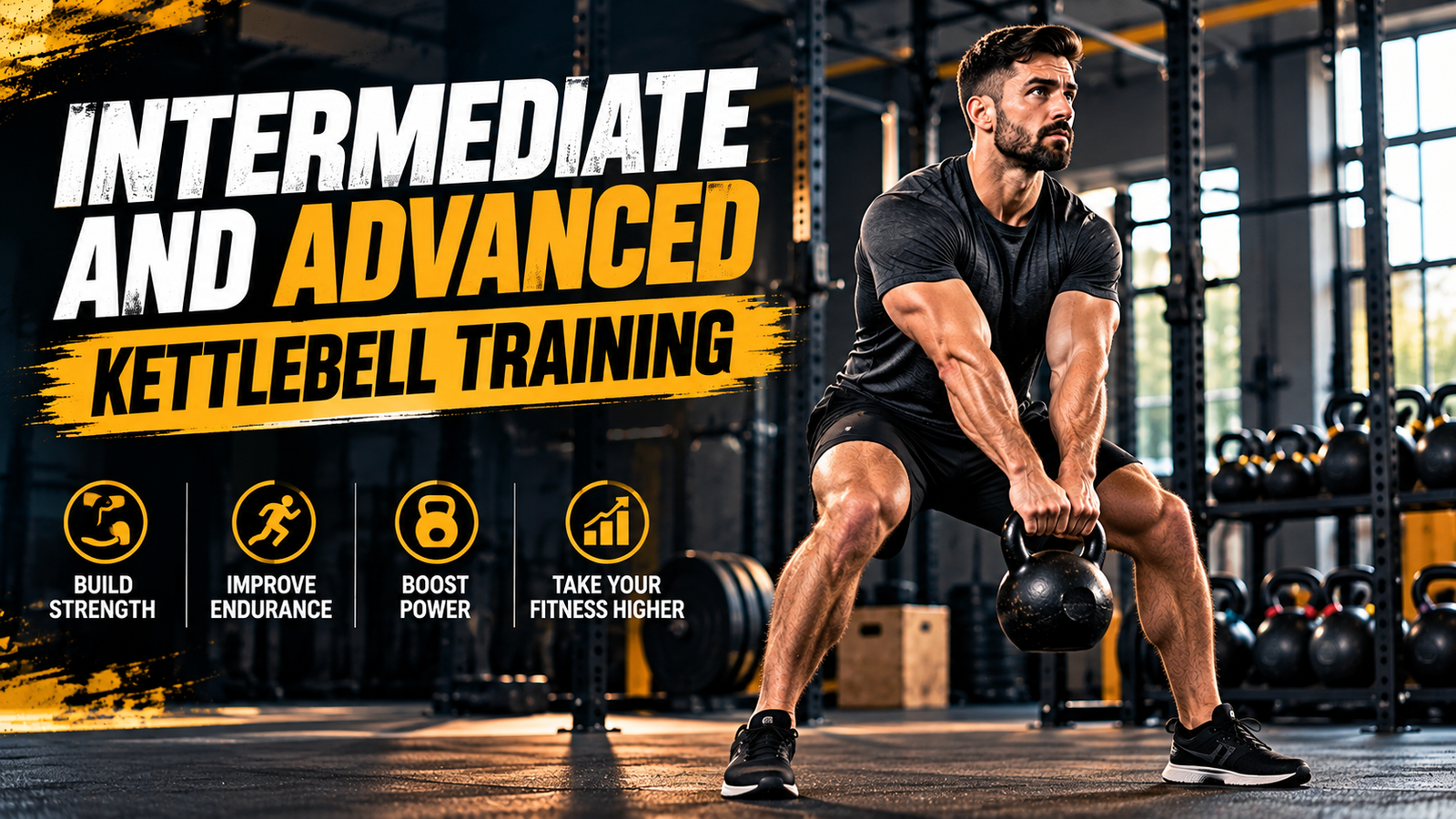
Intermediate and Advanced Kettlebell Training helps fitness enthusiasts build functional strength, improve muscular endurance, develop explosive power, and overcome workout plateaus. As traditional exercise routines become less challenging, kettlebell workouts introduce dynamic movements that engage multiple muscle groups while improving balance, coordination, and stability.
Unlike conventional weightlifting, kettlebell exercises combine strength training with controlled, athletic movement. From powerful swings to challenging Turkish get-ups, these exercises can improve full-body performance when performed with proper technique.
This guide explores seven effective kettlebell exercises, structured workout routines, progressive overload strategies, common training mistakes, and recovery techniques to help experienced fitness enthusiasts achieve sustainable results.
What Is Intermediate and Advanced Kettlebell Training?
Intermediate and advanced kettlebell workouts are structured strength and conditioning sessions designed for individuals who have already developed basic kettlebell skills.
Beginners typically focus on fundamental movements, including deadlifts, swings, goblet squats, and basic presses. More experienced individuals gradually introduce complex movements, heavier resistance, unilateral exercises, and demanding training combinations.
Intermediate vs. Advanced Kettlebell Training
| Training factor | Intermediate | Advanced |
|---|---|---|
| Exercise complexity | Moderate | High |
| Resistance | Moderate to heavy | Individually challenging |
| Main focus | Strength and technique | Power, strength, and skill |
| Typical exercises | Swings, cleans, presses | Snatches, complexes, double-kettlebell lifts |
| Recovery needs | Moderate | Potentially greater |
Training level should be determined by movement quality, strength, experience, and recovery ability rather than kettlebell weight alone.
Benefits of Intermediate and Advanced Kettlebell Training
Regular kettlebell workouts offer several benefits when incorporated into a balanced fitness program.
1. Builds Functional Strength
Kettlebell exercises engage multiple muscle groups simultaneously. Movements such as cleans, squats, and presses strengthen the legs, hips, shoulders, and core.
This type of training develops strength that supports everyday activities and athletic movements.
2. Improves Cardiovascular Endurance
Continuous kettlebell movements can elevate heart rate and challenge cardiovascular fitness.
Exercises such as swings and snatches can be incorporated into conditioning intervals to develop work capacity.
3. Develops Explosive Power
Ballistic movements require rapid hip extension and coordinated muscle activation.
When performed correctly, kettlebell swings and cleans can support the development of explosive strength.
4. Enhances Core Stability
Unilateral kettlebell exercises challenge the body’s ability to resist unwanted rotation and maintain proper alignment.
Movements such as suitcase carries and Turkish get-ups are particularly useful for developing trunk control.
5. Supports Workout Variety
Introducing new movement patterns and carefully planned progression can make training more engaging.
However, variety should complement consistent practice rather than replace structured progression.
7 Powerful Intermediate and Advanced Kettlebell Exercises
The following exercises provide different challenges for strength, power, coordination, and conditioning.
1. Kettlebell Swing
The kettlebell swing is a foundational ballistic exercise that strengthens the posterior chain, including the glutes, hamstrings, and back muscles.
How to perform:
-
Stand with feet approximately shoulder-width apart.
-
Position the kettlebell slightly in front of the body.
-
Hinge at the hips while keeping the spine neutral.
-
Hike the kettlebell backward between the legs.
-
Drive the hips forward to propel the kettlebell upward.
-
Allow it to swing back naturally before repeating.
Suggested training: 3 sets of 10–15 repetitions.
The movement should be powered primarily by hip extension rather than lifting with the arms.
2. Kettlebell Clean and Press
The clean and press combines lower-body power, upper-body strength, and coordination.
How to perform:
-
Begin with the kettlebell positioned near the feet.
-
Hinge at the hips and initiate a controlled clean.
-
Guide the kettlebell smoothly into the rack position.
-
Brace the core and press the weight overhead.
-
Lower it to the rack position before repeating.
Suggested training: 3 sets of 5–8 repetitions per arm.
The kettlebell should rotate smoothly around the hand during the clean rather than crashing against the forearm.
3. Turkish Get-Up
The Turkish get-up develops shoulder stability, body awareness, mobility, and coordinated full-body strength.
How to perform:
-
Begin lying on the floor with the kettlebell held above one shoulder.
-
Bend the knee on the same side as the raised arm.
-
Roll onto the opposite elbow, then extend that supporting arm.
-
Lift the hips and move the extended leg underneath the body.
-
Transition into a half-kneeling position.
-
Stand while keeping the kettlebell stable overhead.
-
Reverse each step carefully.
Suggested training: 2–3 sets of 2–3 repetitions per side.
This complex movement should initially be practiced without weight or with very light resistance.
4. Double Kettlebell Front Squat
The double kettlebell front squat challenges lower-body strength while demanding substantial trunk stability.
How to perform:
-
Clean two kettlebells into the front rack position.
-
Stand with feet approximately shoulder-width apart.
-
Brace the abdominal muscles.
-
Bend the knees and hips to descend into a squat.
-
Maintain balance and an upright, controlled torso.
-
Push through the feet to return to standing.
Suggested training: 3 sets of 6–10 repetitions.
The squat depth should match the individual’s available mobility and ability to maintain proper alignment.
5. Kettlebell Snatch
The kettlebell snatch is an advanced movement that transfers power from the hips through the upper body into a stable overhead position.
How to perform:
-
Begin with a controlled one-arm backswing.
-
Extend the hips explosively.
-
Keep the kettlebell close to the body as it travels upward.
-
Guide the hand smoothly into the handle.
-
Finish with the arm extended overhead.
-
Return the kettlebell safely into the next repetition.
Suggested training: 3 sets of 5–8 repetitions per arm.
Individuals should master one-arm swings, cleans, and overhead stabilization before attempting heavier snatches.
6. Kettlebell Windmill
The windmill develops controlled hip movement, trunk stability, and shoulder positioning.
How to perform:
-
Hold a kettlebell overhead with the arm extended.
-
Position the feet comfortably apart.
-
Turn the feet slightly away from the loaded side as appropriate.
-
Hinge through the hips while maintaining overhead stability.
-
Lower the free hand toward the leg or floor within a comfortable range.
-
Return to standing with control.
Suggested training: 2–3 sets of 5–6 repetitions per side.
A lighter kettlebell is preferable while developing the movement pattern.
7. Kettlebell Farmer’s Carry
Farmer’s carries strengthen grip, trunk muscles, and postural endurance.
How to perform:
-
Position one kettlebell beside each foot.
-
Hinge and lift the weights with a stable spine.
-
Stand tall with shoulders comfortably positioned.
-
Walk at a controlled pace.
-
Avoid excessive leaning or swinging.
-
Lower the kettlebells carefully after completing the distance.
Suggested training: 3 rounds of 20–40 meters.
A single-kettlebell suitcase carry can provide an additional anti-lateral-flexion challenge.
Intermediate Kettlebell Workout Routine
An intermediate routine should combine strength development, conditioning, and manageable recovery demands.
| Exercise | Sets | Repetitions |
|---|---|---|
| Two-hand swings | 3 | 12 |
| Goblet squats | 3 | 10 |
| Clean and press | 3 | 6 per arm |
| One-arm rows | 3 | 10 per arm |
| Farmer’s carry | 3 | 30 meters |
Rest approximately 60–120 seconds between sets, adjusting according to the exercise and training intensity.
This session can be performed two or three times per week when recovery and total training volume are appropriate.
Advanced Kettlebell Workout Routine
Advanced athletes can incorporate more complex exercises while maintaining a strong emphasis on technique.
| Exercise | Sets | Repetitions |
|---|---|---|
| Double kettlebell front squat | 4 | 6 |
| Kettlebell snatch | 4 | 5 per arm |
| Double clean and press | 3 | 6 |
| Turkish get-up | 3 | 2 per side |
| Farmer’s carry | 3 | 40 meters |
Rest approximately 90–180 seconds between demanding strength sets, with longer breaks when necessary.
Advanced sessions do not need to be exhausting to be effective. Quality repetitions and consistent progression are more valuable than excessive training volume.
How to Apply Progressive Overload in Kettlebell Training
Progressive overload involves gradually increasing training demands as the body adapts.
Increase Resistance Gradually
Once an individual can perform all prescribed repetitions with stable technique, a heavier kettlebell may become appropriate.
Because kettlebell weight increments can be relatively large, increasing resistance should not be rushed.
Increase Training Volume
Adding repetitions or an extra set can increase the total workload without requiring heavier equipment.
However, additional volume should be introduced only when recovery remains adequate.
Improve Movement Complexity
An athlete might progress from two-hand swings to one-arm swings or from goblet squats to double front squats.
Each progression should be earned through consistent technical proficiency.
Adjust Rest Periods
Shorter rest periods can increase conditioning demands, but they are not always appropriate for maximal strength or technically complex movements.
Rest duration should support the intended training goal.
Common Kettlebell Training Mistakes to Avoid
Even experienced individuals can develop habits that reduce training quality.
Using Excessive Weight
Choosing a kettlebell that is too heavy may compromise control, particularly during overhead movements.
A manageable load allows individuals to maintain better technique.
Ignoring Proper Hip Mechanics
Many kettlebell exercises rely on efficient hip hinging.
Turning a swing into a squat or lifting primarily with the shoulders can reduce movement efficiency.
Skipping Warm-Ups
A suitable warm-up prepares the body for demanding movements.
Five to ten minutes of light activity, mobility exercises, and progressively heavier practice sets can help athletes transition into their sessions.
Training Without Adequate Recovery
Repeated high-intensity workouts without sufficient recovery may increase fatigue and negatively affect performance.
Rest days, sleep, and appropriate nutrition are important parts of sustainable training.
Prioritizing Speed Over Technique
Performing repetitions too quickly can make it difficult to maintain control.
Movement quality should remain consistent throughout every set.
How Often Should Experienced Athletes Train With Kettlebells?
Training frequency depends on individual goals, experience, exercise intensity, and recovery capacity.
For many individuals, two to four kettlebell sessions per week can provide a practical starting framework.
A balanced schedule might include:
| Day | Training focus |
|---|---|
| Monday | Strength and technique |
| Tuesday | Walking or mobility |
| Wednesday | Power and conditioning |
| Thursday | Rest |
| Friday | Full-body strength |
| Saturday | Optional light activity |
| Sunday | Rest |
Athletes performing other demanding workouts should account for their total weekly training load.

Nutrition and Recovery for Better Kettlebell Performance
Consistent progress requires more than challenging workouts.
Eat Enough Protein
Protein supports muscle repair and adaptation after resistance training.
Individuals can meet their needs through foods such as eggs, fish, lean meat, dairy products, beans, and lentils.
Maintain Adequate Hydration
Fluid requirements vary according to body size, exercise duration, temperature, and sweat losses.
Drinking regularly and replacing fluids lost during exercise can support performance.
Prioritize Quality Sleep
Most adults benefit from approximately seven to nine hours of sleep each night.
Adequate sleep supports recovery, concentration, and overall well-being.
Include Recovery Days
Lower-intensity activities such as walking and gentle mobility exercises can complement demanding strength sessions.
Recovery should be adjusted according to fatigue, soreness, and performance.
Frequently Asked Questions
Is kettlebell training effective for building muscle?
Yes. Kettlebell resistance exercises can support muscle growth when training volume, resistance, nutrition, and recovery are appropriate. Heavier kettlebells and progressively challenging exercises are often necessary for continued development.
Can advanced kettlebell workouts replace gym training?
They can provide substantial strength and conditioning benefits. However, individuals focused on maximal strength or highly specific muscle development may benefit from additional equipment.
What kettlebell weight should intermediate athletes use?
There is no universal weight. The appropriate resistance depends on the exercise, body size, strength, experience, and technical ability.
Are kettlebell snatches safe for everyone?
No. Snatches require adequate technique, overhead mobility, coordination, and strength. Individuals with relevant injuries or limitations should seek qualified professional guidance before attempting them.
How long should a kettlebell workout last?
Many structured sessions last approximately 30–60 minutes, including warm-up and cooldown. The ideal duration depends on training goals and workout intensity.
Conclusion
Intermediate and Advanced Kettlebell Training offers an effective approach to developing functional strength, muscular endurance, coordination, and explosive power.
Exercises such as swings, cleans, snatches, Turkish get-ups, and loaded carries provide varied challenges for experienced fitness enthusiasts.
The most sustainable results come from proper technique, progressive overload, balanced workout programming, and adequate recovery. By increasing training demands gradually and maintaining consistency, individuals can continue improving their fitness while reducing unnecessary training risks.