Calisthenics Workout No Equipment: Complete Beginner Guide
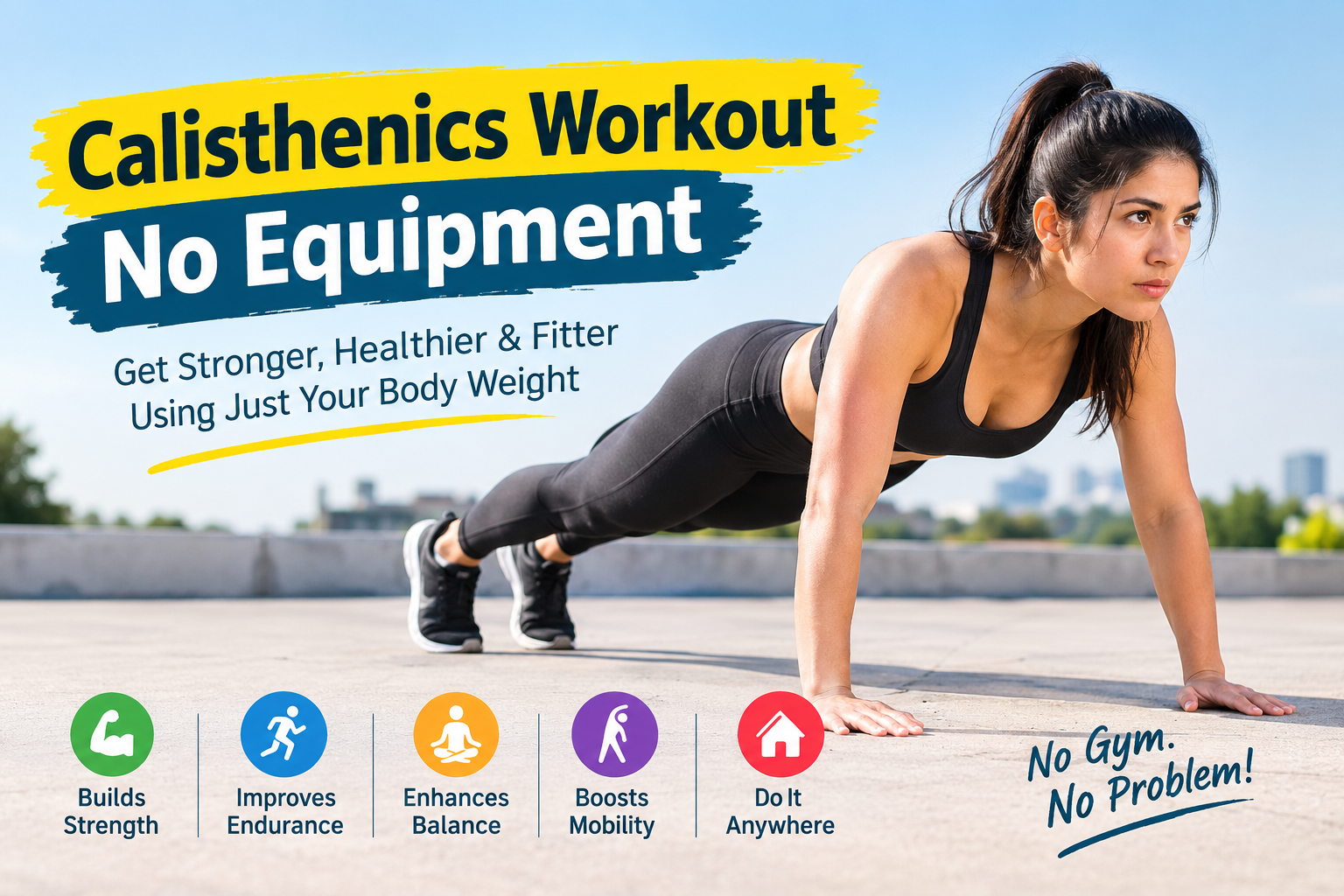
A calisthenics workout no equipment routine is a simple way to improve strength, endurance, balance, and mobility by using body weight as resistance. Unlike traditional gym workouts, it does not require dumbbells, weight machines, or expensive equipment. With enough space to move safely, beginners can perform many effective exercises at home or outdoors.
For people who want a convenient workout that fits easily into a busy schedule, bodyweight training can be a practical choice. The exercises can also be adjusted according to individual fitness levels, making them suitable for beginners and more experienced trainees.
What Is Calisthenics?
Calisthenics is a form of exercise that primarily uses body weight for resistance. Common movements include squats, push-ups, lunges, planks, and other bodyweight exercises.
The difficulty of these exercises can be changed by adjusting repetitions, movement speed, range of motion, rest periods, or exercise variations. This allows a person to start with simple movements and gradually progress as strength improves.
Benefits of a No-Equipment Workout
Builds Full-Body Strength
Bodyweight exercises can train several major muscle groups during a single workout. Squats and lunges work the legs, while push-ups target the upper body. Planks and mountain climbers can strengthen the core.
A balanced routine can therefore provide a full-body workout without requiring multiple pieces of equipment.
Easy to Perform at Home
One major benefit is convenience. Most exercises can be performed in a bedroom, living room, backyard, or another clear space.
This can make exercise easier to fit into a daily routine, especially for people who do not have access to a gym.
Improves Body Control
Calisthenics involves more than simply moving through repetitions. Many exercises require balance, coordination, stability, and controlled movement.
With regular practice, a person can become more comfortable controlling body position during different movements.
Supports Consistent Training
Because little or no equipment is required, there are fewer barriers to starting a workout. A person can complete a short session even when there is limited time available.
Consistency is often more useful than occasionally completing an extremely difficult workout.
7 Beginner Exercises to Try
1. Bodyweight Squats
Bodyweight squats are a basic lower-body exercise that targets the quadriceps, glutes, and hamstrings.
Stand with the feet around shoulder-width apart. Lower the hips while bending the knees, keeping the movement controlled. Then push through the feet to return to the starting position.
Beginners can start with 8–15 repetitions.
2. Push-Ups
Push-ups train the chest, shoulders, triceps, and core. They are one of the most useful upper-body movements in a calisthenics workout no equipment routine.
Beginners who find standard push-ups difficult can start with knee push-ups or an easier variation. As strength improves, standard push-ups can become the next goal.
3. Reverse Lunges
Reverse lunges work the legs and glutes while also challenging balance.
Start standing upright, step one foot backward, and lower the body under control. Push through the front foot to return to the starting position.
Performing the exercise slowly can help beginners focus on stability and technique.
4. Glute Bridges
Glute bridges are performed while lying on the back with the knees bent and feet on the floor.
Lift the hips while squeezing the glutes, pause briefly, and then lower the hips slowly. This movement can help strengthen the glutes and introduce controlled hip extension.
5. Planks
Planks are an isometric exercise that challenges the core and overall body stability.
Beginners can hold a plank for around 15–30 seconds and gradually increase the duration as they become stronger. Maintaining proper alignment is more important than holding the position for a very long time.
6. Mountain Climbers
Mountain climbers combine core stability with dynamic movement.
Start in a high-plank position and alternate bringing the knees toward the chest. Beginners can perform the movement slowly before increasing speed.
7. Calf Raises
Calf raises are a simple way to train the lower legs.
Stand upright, raise the heels from the floor, pause briefly, and lower them with control. A wall can be used for balance if necessary.
Sample Beginner Workout Routine
A beginner does not need to perform every exercise for a long time. A simple workout can include:
| Exercise | Sets | Repetitions |
|---|---|---|
| Bodyweight squats | 3 | 10–15 |
| Push-ups | 3 | 5–12 |
| Reverse lunges | 2 | 8–10 per leg |
| Glute bridges | 3 | 10–15 |
| Plank | 2 | 15–30 seconds |
| Calf raises | 3 | 12–20 |
A short warm-up should be completed before the workout. Beginners can also rest for around 60–90 seconds between challenging sets, adjusting the rest period when necessary.
How to Progress Without Equipment
Progressive overload does not always require heavier weights. A person can make bodyweight training harder in several ways.
First, repetitions can be increased when the current number becomes comfortable. Another option is adding an extra set to increase total training volume.
Slowing the movement can also make an exercise more challenging. For example, taking several seconds to lower during a squat or push-up increases the time spent under tension.
Another method is progressing to a more difficult variation. A beginner might move from knee push-ups to standard push-ups and eventually to more advanced variations.
Progress should be gradual. Increasing difficulty too quickly can make it harder to maintain good technique and recover properly.
Common Mistakes to Avoid
One common mistake is doing too much too soon. Beginners may feel motivated to train every day, but muscles need time to recover after demanding sessions.
Another mistake is sacrificing form to complete more repetitions. Controlled movement should remain a priority throughout the workout.
It is also important not to compare progress with other people. Fitness levels and training backgrounds vary, so progress should be measured against personal performance.
How Often Should Beginners Train?
Beginners can generally start with two or three bodyweight workouts per week. For example, workouts can be scheduled on Monday, Wednesday, and Friday.
The remaining days can be used for rest, walking, mobility work, or other light activities.
As fitness improves, workout volume and exercise difficulty can be adjusted. The goal should be to create a routine that is realistic enough to maintain consistently.
Final Thoughts
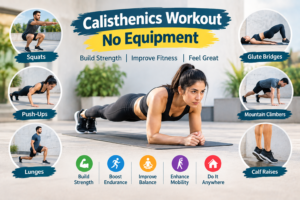
A calisthenics workout no equipment routine can provide an accessible way to develop strength, endurance, balance, and body control without a gym or expensive equipment. Exercises such as squats, push-ups, lunges, glute bridges, planks, mountain climbers, and calf raises can create a balanced beginner workout.
The most important factors are proper technique, gradual progression, adequate recovery, and consistency. By starting with manageable exercises and increasing the challenge over time, beginners can build a sustainable bodyweight training routine.