
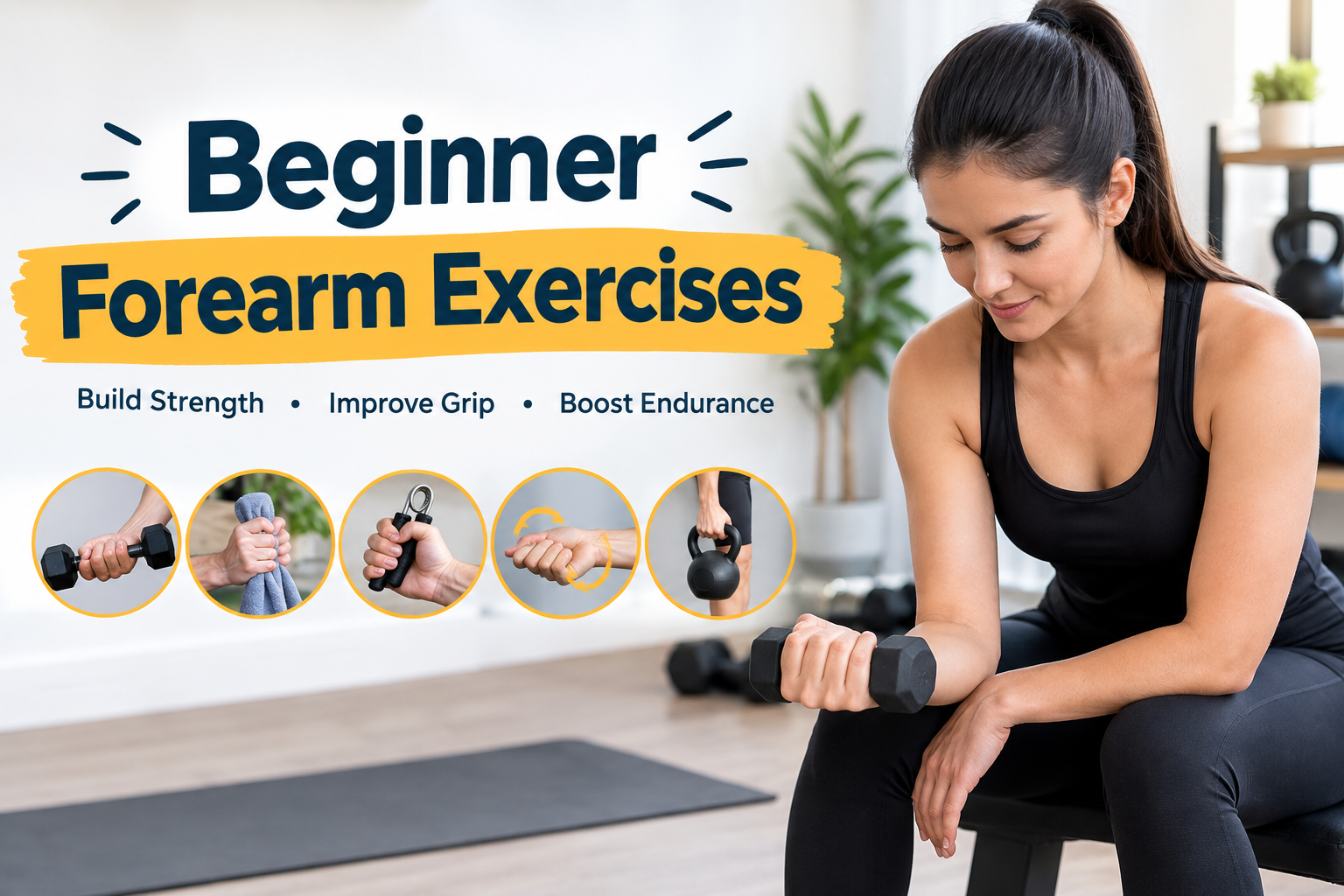
Beginner Forearm Exercises can help newcomers build grip strength, improve wrist control, and support better performance in everyday activities and strength training. The forearms may be small compared with larger muscle groups, but they play an important role in carrying, lifting, pulling, and holding objects. Fortunately, beginners do not need complicated equipment or advanced techniques to start training them. With a few simple movements, proper form, and consistent practice, a beginner-friendly routine can gradually improve forearm strength and endurance.
Why Forearm Strength Matters
The forearms contain muscles that help control the wrist, fingers, and grip. These muscles work during activities such as opening jars, carrying shopping bags, typing, and using exercise equipment.
Stronger forearms can also support exercises such as rows, deadlifts, pull-ups, and dumbbell training. Better grip endurance may help a person hold weights more comfortably and maintain control during workouts.
However, forearm training is not only about lifting heavier weights. It is also about developing balanced strength, improving control, and reducing the likelihood of fatigue during activities that require repeated gripping.
Beginner Forearm Exercises to Try
The following exercises are suitable starting points for people who are new to forearm training. They can be performed at home or in a gym, depending on the available equipment.
1. Wrist Curls
Wrist curls primarily target the muscles on the underside of the forearm.
How to perform them:
- Sit on a bench or chair and hold a light dumbbell in each hand.
- Rest the forearms on the thighs or a bench, with the palms facing upward.
- Allow the wrists to extend slightly toward the floor.
- Curl the weights upward by moving only the wrists.
- Lower the weights slowly and repeat.
A beginner can start with 2 sets of 10–15 repetitions. The movement should remain controlled rather than relying on momentum.
2. Reverse Wrist Curls
Reverse wrist curls work the muscles on the upper side of the forearm and help develop balanced wrist strength.
How to perform them:
- Hold light dumbbells with the palms facing downward.
- Rest the forearms on the thighs or a bench.
- Keep the arms still while raising the backs of the hands.
- Lower the weights slowly to the starting position.
Because these muscles are often weaker, beginners should use lighter weights than they might expect.
3. Farmer’s Carries
Farmer’s carries are a practical exercise for improving grip strength, forearm endurance, and overall stability.
How to perform them:
- Hold a dumbbell or kettlebell in each hand.
- Stand upright with the shoulders relaxed and the core engaged.
- Walk slowly for a comfortable distance while maintaining a firm grip.
- Place the weights down safely and rest before repeating.
A beginner can begin with 2–3 rounds of 20–30 seconds. The weight should be challenging but manageable enough to maintain good posture.
4. Towel Squeezes
Towel squeezes are a simple option for home workouts and require little or no gym equipment.
How to perform them:
- Roll a small towel into a manageable shape.
- Hold it in one hand.
- Squeeze firmly for 5–10 seconds.
- Relax the hand and repeat.
- Switch hands.
This exercise can help beginners practice grip endurance without using heavy weights.
5. Wrist Rotations
Wrist rotations help beginners improve wrist mobility and control while gently engaging the forearm muscles.
How to perform them:
- Extend the arms comfortably in front of the body.
- Make slow circles with the wrists.
- Complete several rotations in one direction.
- Reverse the direction.
- Keep the movements smooth and pain-free.
Wrist rotations can be used as part of a warm-up or as a light mobility exercise between strength-training sets.
6. Hand Gripper Squeezes
A hand gripper can provide adjustable resistance for grip training. It is useful for beginners who want to focus on squeezing strength.
How to perform them:
- Place the gripper comfortably in one hand.
- Squeeze the handles together without straining the wrist.
- Hold briefly if comfortable.
- Release slowly.
- Repeat for the desired number of repetitions.
Beginners should choose a resistance that allows controlled repetitions rather than forcing the handles closed.
How to Build a Beginner Forearm Workout
A simple routine does not need to be long. Beginners can train the forearms two or three times per week, allowing recovery between sessions.
A sample routine may include:
| Exercise | Sets | Repetitions or Time |
|---|---|---|
| Wrist curls | 2 | 10–15 |
| Reverse wrist curls | 2 | 10–15 |
| Farmer’s carries | 2 | 20–30 seconds |
| Towel squeezes | 2 | 8–12 squeezes per hand |
The routine can be adjusted according to fitness level, equipment, and recovery. Beginners may start with fewer exercises and gradually add volume as strength improves.
Tips for Safe and Effective Forearm Training
Start With Light Resistance
Forearm muscles can fatigue quickly, especially when a person is new to resistance training. Light weights allow beginners to learn the movement and maintain control.
Focus on Proper Form
The wrists should move smoothly, while the elbows and forearms remain stable when required. Jerky movements can place unnecessary stress on the joints.
Increase Difficulty Gradually
As an exercise becomes easier, a beginner can increase the resistance, repetitions, or duration slightly. Progress should be gradual rather than sudden.
Allow Time for Recovery
Forearm muscles are involved in many daily tasks and upper-body exercises. Rest days can help reduce excessive fatigue and support steady progress.
Stop if Pain Occurs
Mild muscle fatigue is normal, but sharp pain, persistent discomfort, or unusual swelling should not be ignored. Anyone with a wrist or forearm injury should seek professional guidance before beginning a new routine.
Common Mistakes Beginners Should Avoid
Some common mistakes can slow progress or increase discomfort:
- Using weights that are too heavy.
- Moving the entire arm instead of isolating the wrist.
- Performing repetitions too quickly.
- Training the forearms every day without recovery.
- Ignoring wrist discomfort.
- Focusing only on grip strength while neglecting wrist control and endurance.
A balanced approach usually produces better long-term results than trying to exhaust the muscles in every session.
How Long Does It Take to Improve Forearm Strength?
Progress varies from person to person. Beginners may notice improved grip control and endurance after several weeks of consistent training. Visible muscle development generally takes longer and depends on factors such as training frequency, resistance, nutrition, sleep, and genetics.
The most important factor is consistency. A manageable routine performed regularly is more useful than an intense workout that causes excessive soreness or is difficult to maintain.
Conclusion
Beginner Forearm Exercises offer a practical way to improve grip strength, wrist control, and forearm endurance without requiring an advanced training background. Exercises such as wrist curls, reverse wrist curls, farmer’s carries, towel squeezes, and wrist rotations can help beginners build a strong foundation. By using proper form, starting with manageable resistance, and allowing enough recovery, beginners can make steady progress and develop forearms that support both everyday activities and broader fitness goals.