
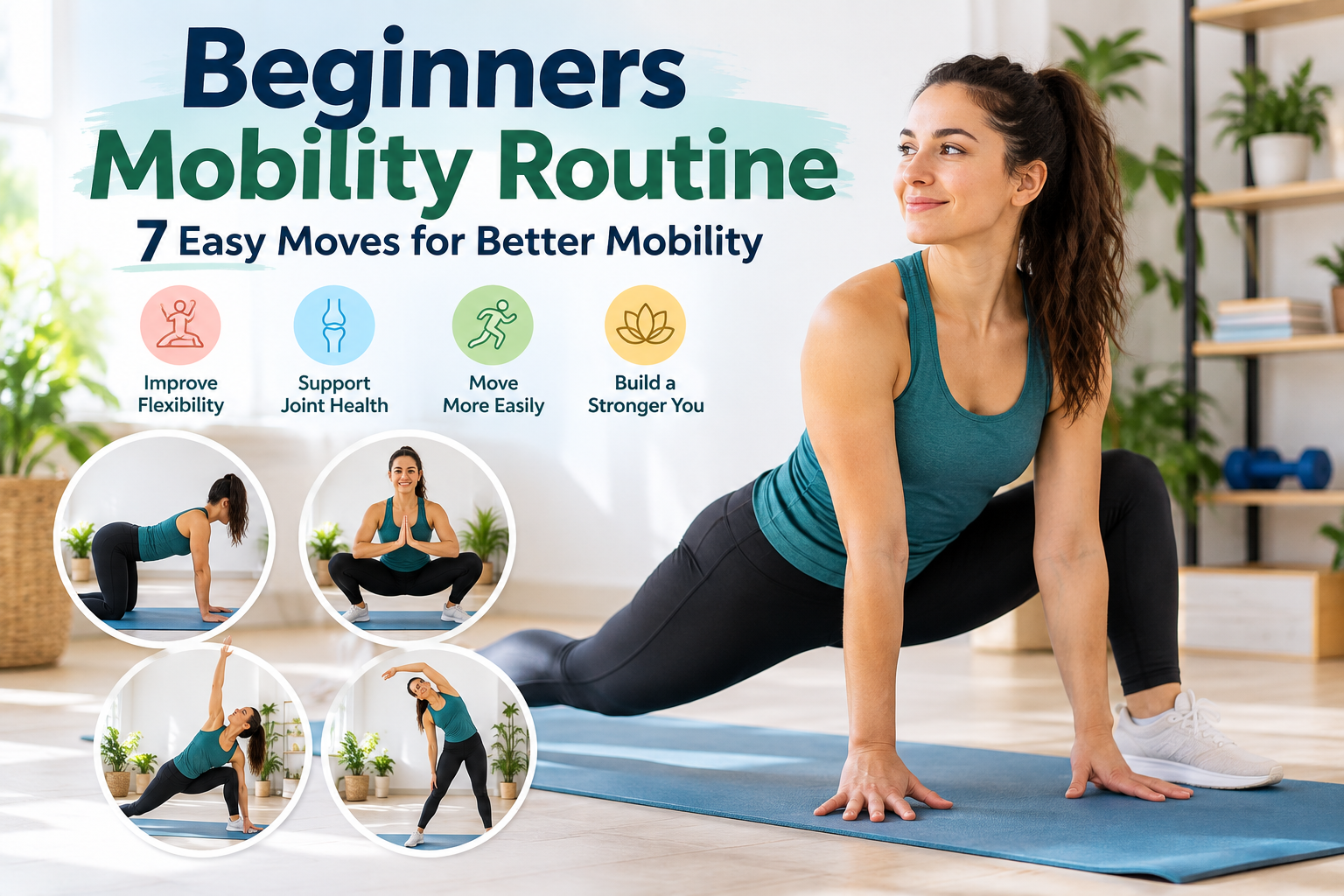
Beginners Mobility Routine: Simple Exercises to Move Better
Beginners Mobility Routine exercises can help a person improve flexibility, joint movement, body control, and overall comfort during everyday activities. For someone who is new to fitness, mobility training provides a simple way to prepare the body for exercise while gradually improving how freely it moves.
Stiff hips, tight shoulders, and limited ankle movement can make workouts and daily activities more difficult. A consistent mobility routine can address these limitations without requiring complicated equipment or long training sessions.
This guide explains beginner-friendly mobility exercises, their benefits, proper technique, and how a person can build a realistic routine that is easy to maintain.
What Is a Beginners Mobility Routine?
A Beginners Mobility Routine is a series of controlled movements designed to help joints move comfortably through their natural range of motion. Unlike a demanding workout, mobility training focuses primarily on movement quality, control, and gradually improving range of motion.
Mobility is also slightly different from flexibility. Flexibility generally describes how much a muscle can lengthen, while mobility involves the ability to actively control movement around a joint.
For beginners, both can be useful. Better mobility may make movements such as squatting, reaching overhead, bending, walking, and exercising feel more comfortable.
Why Is Mobility Important for Beginners?
Many people spend several hours each day sitting at a desk, driving, or looking at screens. Over time, a lack of regular movement can contribute to feelings of stiffness.
Mobility exercises encourage the body to move in different directions and can help a beginner become more comfortable with common movement patterns.
Regular mobility work may help with:
- Improving comfortable joint range of motion
- Reducing feelings of stiffness
- Preparing the body for exercise
- Improving movement control
- Supporting better exercise technique
- Making everyday movements feel easier
Mobility training does not need to be intense. Consistency and controlled movement are generally more important than trying to force the body into a deeper position.
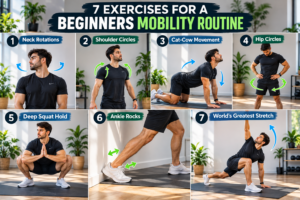
7 Exercises for a Beginners Mobility Routine
The following exercises target several major areas of the body. Each movement should be performed slowly and within a comfortable range.
1. Neck Rotations
Neck rotations are a gentle way to introduce movement around the neck.
A person can sit or stand upright with relaxed shoulders. The head can then turn slowly toward one side before returning to the center and moving toward the other side.
The movement should remain controlled rather than forced.
Suggested amount: 5–8 repetitions on each side.
2. Shoulder Circles
Shoulder circles can help prepare the shoulders and upper body for movement.
A person begins with the arms relaxed beside the body. The shoulders are slowly rolled forward in smooth circles before changing direction.
Larger circles can gradually be introduced as the movement becomes comfortable.
Suggested amount: 8–10 circles in each direction.
3. Cat-Cow Movement
Cat-cow is a popular mobility movement for the spine.
A person begins on the hands and knees. While breathing in, the chest gently moves forward as the back arches slightly. While breathing out, the back rounds comfortably and the head lowers.
The goal is smooth spinal movement rather than speed.
Suggested amount: 8–10 controlled repetitions.
4. Hip Circles
Hip circles introduce gentle movement around the hips.
While standing with the feet approximately shoulder-width apart, a person can place the hands on the hips and slowly move them in a circular pattern.
The circles should remain comfortable and controlled.
Suggested amount: 8 circles in each direction.
5. Deep Squat Hold
A supported deep squat can help work on hip and ankle mobility.
A beginner can stand with the feet slightly wider than hip-width and gradually lower into a comfortable squat. Holding a stable object for support can make the movement easier.
There is no need to reach a very deep position immediately. The depth can gradually improve as mobility develops.
Suggested amount: Hold for 15–30 seconds.
6. Ankle Rocks
Ankle mobility plays an important role in walking, running, lunging, and squatting.
A person can stand facing a wall with one foot forward. Keeping the heel on the floor, the front knee gently moves toward the wall before returning to the starting position.
The heel should remain down throughout the movement.
Suggested amount: 8–12 repetitions per ankle.
7. World’s Greatest Stretch
Despite its name, this movement combines several mobility elements rather than focusing on only one muscle.
A person begins in a lunge position with both hands near the front foot. The upper body then gently rotates as one arm reaches toward the ceiling. After returning to the starting position, the movement can be repeated on the opposite side.
Beginners should use a comfortable range rather than trying to maximize the stretch.
Suggested amount: 5 repetitions on each side.
How to Build a Simple Daily Mobility Routine
A mobility session does not have to take 30 or 60 minutes. For many beginners, starting with approximately 5–10 minutes can make the habit easier to maintain.
A simple routine could include shoulder circles, cat-cow movements, hip circles, ankle rocks, a supported squat hold, and gentle rotational movements.
Each exercise can be performed for around 30–60 seconds before moving to the next one.
The routine can be completed before a workout, after periods of prolonged sitting, or as a separate movement session.
Beginners Mobility Routine Before a Workout
A short Beginners Mobility Routine can also be incorporated into a warm-up.
Before strength training or other exercise, dynamic mobility movements are generally more practical than spending a long time holding static stretches. Hip circles, shoulder rotations, ankle rocks, and controlled squats can gradually prepare the body for the movements that follow.
The exercises selected should also reflect the upcoming workout. Someone preparing for a lower-body session, for example, may give additional attention to the hips and ankles.
How Often Should Beginners Practice Mobility?
Beginners can perform gentle mobility work regularly, provided the movements remain comfortable.
A short session several times per week can be easier to maintain than an occasional long session. Some people may also enjoy performing a few minutes of mobility work every day.
Progress does not need to happen quickly. The body can gradually become more comfortable with movement through consistent practice.
Common Mobility Mistakes Beginners Should Avoid
Moving Too Quickly
Mobility exercises should generally be performed with control. Rushing through repetitions can reduce the opportunity to focus on movement quality.
Forcing the Range of Motion
A beginner does not need to copy the range of motion of an experienced athlete. Mobility should gradually improve rather than being forced.
Sharp or unusual pain is a reason to stop the movement and seek appropriate professional guidance when necessary.
Holding the Breath
Steady breathing can help a person stay relaxed during mobility exercises. Breathing normally is usually better than holding the breath while trying to reach a deeper position.
Expecting Immediate Results
Mobility develops gradually. A person may notice some movements becoming more comfortable relatively quickly, while other limitations can require more time and consistent practice.
Being Inconsistent
Performing mobility exercises once and then ignoring them for several weeks is unlikely to build a strong habit. Short, regular sessions are often more practical.
Mobility vs. Stretching: What Is the Difference?
Mobility and stretching are related but are not exactly the same.
Stretching often focuses on lengthening muscles and may involve holding a particular position. Mobility training usually involves actively moving a joint through a comfortable range while maintaining control.
For example, holding a hamstring stretch primarily targets flexibility, while performing controlled hip movements requires active movement and coordination.
A balanced fitness routine can include both approaches.
Tips for Making Mobility Training Sustainable
The best routine is usually one a person can realistically maintain.
A beginner can start with only a few movements rather than trying to complete a long routine immediately. Exercises can also be attached to an existing habit, such as a morning routine or regular workout.
Tracking improvements can provide additional motivation. A person might notice that squats become more comfortable, reaching overhead feels easier, or certain everyday movements require less effort.
Progress should be judged by improved movement quality rather than by how extreme a stretch looks.
Who Can Benefit From Mobility Exercises?
Mobility exercises are not limited to athletes.
People who sit for long periods, beginners starting strength training, recreational runners, gym-goers, and individuals who simply want to maintain comfortable movement may all find mobility work useful.
However, anyone recovering from an injury, experiencing persistent pain, or living with a condition that affects movement should consider seeking guidance from a qualified healthcare professional before starting unfamiliar exercises.
Conclusion
A Beginners Mobility Routine provides a simple and practical way to work on flexibility, joint movement, body control, and overall movement quality. It does not require expensive equipment or lengthy training sessions.
Exercises such as shoulder circles, cat-cow movements, hip circles, ankle rocks, supported squats, and controlled stretches can create a well-rounded starting point.
Most importantly, beginners should focus on comfortable, controlled movements and consistent practice rather than trying to achieve advanced ranges of motion immediately. Even a few minutes of regular mobility work can help establish a sustainable movement habit.










[…] and some repetition requirements vary by race division. Beginners should check the current official HYROX rulebook before choosing their competition […]